Traditional Artisanal Methods in the Pink City
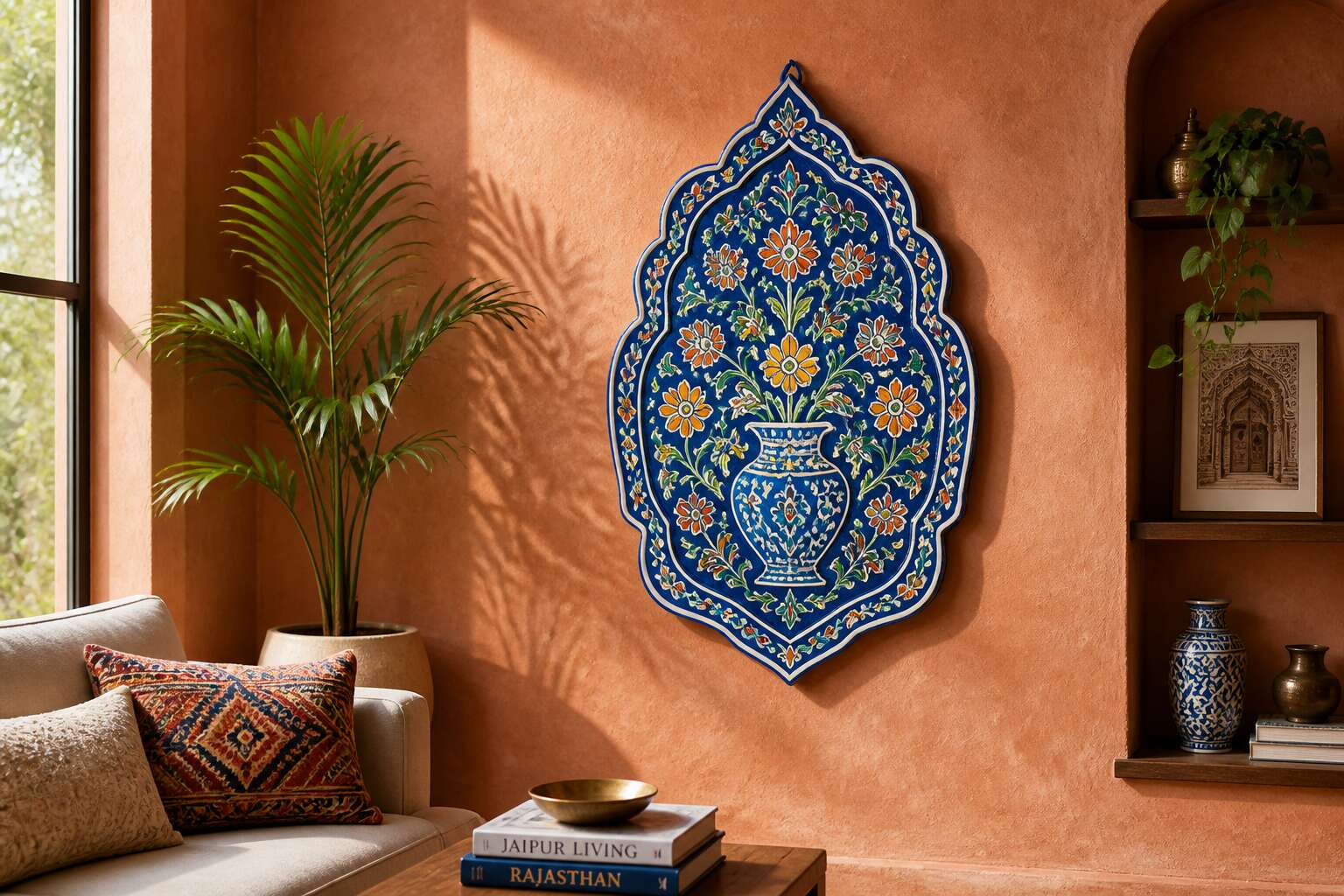
Blue Pottery Wall Tiles and Accents
Within Jaipur’s old quarters, Blue Pottery still follows a disciplined process. Artisans fuse quartz powder with glass frit and katai gum, shaping tiles that withstand the city’s heat. Every cobalt brushstroke is laid by hand, often traced from Mughal botanical motifs passed down through families.
The kiln’s low firing temperature, around 800 degrees Celsius, produces a distinctive crackle, a network of tiny lines that no two pieces share. For wall decor jaipur, these tiles offer both beauty and lineage.
I once watched a potter rotate a tile, and such quiet confidence! He corrected a leaf’s curve with a single, sure stroke. That discipline, that unhurried precision, defines the value of the Pink City’s craft.
Hand-Blocked Textile Hangings
In Jaipur’s bazaars, wooden blocks older than the Republic stamp indigo and madder onto cloth. These hand-blocked textile hangings preserve the city’s visual history. Artisans carve teak blocks with chisels, each motif a geometric pattern. One block takes three days to carve. The cloth is washed in the riverbed, sun-bleached, then aligned with charcoal thread grids. The printer’s hand never wavers.
For wall decor jaipur, these hangings provide a softness that tiles cannot. The dyes settle into the plaster and breathe with the wall.
- Seven separate printings create one repeat pattern.
- Alizarin and indigo resist fading for decades.
Each stamp records a precise exchange of force and timing. A slightly misaligned flower, a human imperfection, confirms the handwork.
Phad Painting Narrative Art
Phad painting is a narrative art form that originated in Shahpura, near Jaipur. Artists called chiteras paint on a cloth treated with starch and gum, using only natural pigments. The finished piece tells the story of a local deity, usually Pabuji or Devnarayan, in a continuous sequence of scenes. The composition is crowded with figures, trees, and animals. Every detail has a purpose.
What makes phad painting distinct is the absence of perspective. The eye travels from episode to episode without a single blank space. This is a functional art form. It serves a purpose beyond ornament. For wall decor jaipur, hanging a phad brings a centuries-old tradition into your room, where it continues to tell its story every time someone looks at it.
Mirror Work and Sheesha Embellishments
A single sliver of mica, no wider than a thumbnail, can hold a room hostage. That is the magic of sheesha work. In Jaipur, artisans set tiny mirrors into fabric using a double-threaded stitch called the herringbone loop. One wrong pull and the glass cracks.
Mirror work in wall decor jaipur does not simply reflect light. It fragments it, scattering pieces of the room across the wall. Each mirror is wrapped and secured individually, a process passed down through generations of kachhi workers. That is why wall decor jaipur carries a living presence, not just a pattern.
- The base cloth is stiffened with a resin to prevent puckering.
- Small circular mirrors are cut and edges smoothed by hand.
- Decorative chains are often added for a heavier finish.
This is not decoration for the impatient. It is an act of repetition, almost meditative. You are buying the hours of focus held in each glass shard. For a home in South Africa, the effect is striking. Light catches the sheesha facets and the wall shimmers like a broken constellation.
Jhumar Swings and Bamboo Frames
In Jaipur, the jhumar swing hangs from a single iron ring, its bamboo frame lashed with wet jute. The cord shrinks as it dries, pulling the joints tight without a nail. This method prevents the wood from splitting. Artisans harvest the bamboo in the dry season, then smoke it over a fire to expel moisture and insects.
Smaller jhumar swings appear as wall decor jaipur. They hold a vase or a lamp instead of a body. The frame sways with the air, moving with the room.
- Choose mature bamboo with no cracks.
- Steam the stalk to make it pliable.
- Lash the crossbars with jute cord.
- Balance the frame on a central hook.
The swing creaks with each passing footstep. The bamboo grain flexes and returns. In the Pink City, this is how a wall decor piece earns its presence.
Materials That Define Rajasthani Wall Aesthetics
Carved Wooden Panels and Jharokha Frames
In Jaipur, a wall is not a boundary but a chronicle. The carved wooden panel is its most honest narrator. Each gouge in the Sheesham wood holds generations of chisel work, and owning one feels like borrowing a fragment of someone’s memory. That is the core appeal of wall decor jaipur; it turns interior design into an archival act. The material is not just a texture, it is a presence.
Then there is the jharokha, the overhanging frame. These were once watchtowers for queens, a place to observe without being observed. To hang one today is to invite that voyeuristic calm into your home. I find the function shifts beautifully. It becomes a physical portal for your own reverie.
The enduring appeal of this style rests on deep relief motifs, jali lattice screens, and dark hardwoods. These details require a commitment to materiality. They do not whisper for attention; they command it. In a world of disposable decor, selecting a solid teak jharokha is a deliberate act of permanence. That continuity is what makes this form of wall decor jaipur profoundly moving.
Wrought Iron and Metal Filigree Wall Art
In Jaipur, metalwork is a craft of contrasts. Wrought iron panels display the city’s raw strength, with dark curves that preserve the mark of furnace and hammer. Filigree, in contrast, uses the same material to create delicate openwork, a fragile geometry that shifts as sunlight moves across the room.
I have always found that contrast necessary. Iron gives weight; filigree gives breath. Together they create a wall display that feels both grounded and airborne. The key is in the patina, that uneven darkening that no machine can replicate.
Notable examples include:
- Hand-forged textures
- Openwork patterns for light play
- Oxidised finishes over polished shine
Each piece becomes a quiet witness to the craftsman’s patience, a reminder that true wall decor jaipur is not manufactured, but forged.
Handwoven Tapestries and Dhurrie Weaves
Handwoven tapestries and dhurrie weaves offer a different texture. These are not paintings or carvings. They are cloth for walls, spun from wool and cotton, dyed with natural pigments. A dhurrie carries the desert’s palette: indigo, madder root, turmeric. The weave is flat, tight, and honest. It does not imitate palace tapestry. It brings warmth to a bare wall.
I have seen wall decor jaipur where fabric is an afterthought. That is a mistake! A good dhurrie changes the acoustics of a room. It softens the echo. It also gives the eye a place to rest. Wall decor jaipur in this weave suits a bedroom or study. Some weavers still work on pit looms. The process is slow, and the patterns are geometric, often named after local villages.
- Earth tones from natural dyes
- Reversible weaving
- Hand-spun yarn for uneven texture
Each piece carries the loom’s rhythm. No two are identical.
Stone Inlay and Latticework Screens
The stone inlay on a Jaipur wall demands a second look. This is not a painted pattern. It is a mosaic of marble and semiprecious stones, each piece cut and fitted by hand. For wall decor jaipur, this technique offers permanence that fabric cannot match. The surface is smooth and cool, catching light in a way that shifts through the day.
Latticework screens, known as jali, perform a different task. Carved from a single slab of stone, they let air and light pass while maintaining privacy. Mounted against a bright wall, a jali screen creates shadows that change hourly.
- Makrana marble, prized for its translucent white
- Dungri sandstone, with deep red tones
- Green malachite, used sparingly for contrast
Each piece retains the markings of its quarry. For those exploring wall decor jaipur, these screens add texture and history to a room.
Painted Papier-Mâché Plates and Dishes
Painted papier mâché plates and dishes carry a delicate weight. In Jaipur, artisans layer paper pulp into rounded forms, then coat them with fine gesso. The painting uses mineral pigments, applied with brushes as thin as a single hair.
These circles are not meant for dining. They are hung in clusters or along a narrow hallway. Their surfaces catch light at odd angles. A single plate can hold a peacock, a lotus, or a trailing vine. For wall decor jaipur, these pieces offer a lighter alternative to stone or wood.
- Floral sprays in deep red and indigo
- Geometric borders in gold leaf
- Scenes of courtly processions
Each plate shows the artist’s hand, with small imperfections that mark authenticity. Mounted on a wall, they bring a texture of old bazaars and patient fingers.
Antique Brass and Copper Wall Bells
The allure of Jaipur’s walls often lies in their weight, their refusal to whisper. Antique brass and copper bells embody this principle of cheerful clamor, objects that were never meant for silence. In Rajasthani homes, these bells hung in courtyards or by the threshold, their clappers tied to announce a visitor. The metals, oxidized by time and weather, develop a patina that no workshop can replicate. Many are crudely finished, bearing the hammer marks of the blacksmith, and it is exactly this honesty that makes them so compelling for wall decor jaipur today.
Arranging these bells is a study in patience. A single, large temple bell commands a space, its deep bronze tones anchoring a minimalist wall. Smaller, varied examples work better in a formation that encourages the eye to wander, grouping them into a constellation of sound and metal.
– The deep, sonorous clang of a large bell, dusted with verdigris.
– A cluster of tiny, high-pitched bells, once tied to bullock carts.
– A single, ornate bell in the shape of a lotus, its surface worn smooth by hands.
The brass or copper base means the piece will never fade, and their acoustic function means they still hold a memory of their purpose. To hang one is to invite a subtle percussive note into the room whenever a door opens or a breeze stirs, a small, metallic rebuke to the stillness of modern interiors. Their value lies not in their age alone, but in the daily life they once animated, a tangible connection to a busier, more audible past.
Contemporary Interpretations for Modern Homes
Minimalist Thangka and Folk Art Prints
Think of a Jaipur wall as a living canvas, fresh interpretations of its sacred arts are redefining contemporary spaces. The city’s artists now distill the complex iconography of Thangka painting into minimalist forms, using uncluttered lines and muted earth tones to capture serenity. These pieces offer a meditative presence, making them a sophisticated choice for those seeking wall decor Jaipur that whispers rather than shouts.
In a similar vein, folk art prints are being reborn through modern printmaking techniques. The bold narratives of rural Rajasthan are translated into sleek, graphic compositions that fit effortlessly into a minimalist apartment. When selecting wall decor Jaipur, consider how these visual mutations can anchor a room. They bring a sense of history and place without overwhelming the senses, creating a dialogue between the old and the new.
These prints work because they prioritize color blocking and precise silhouettes over chaotic detail. For a modern interior, this approach is more than just decoration; it is a curation of cultural memory distilled into pure visual form. A single, large-format print can serve as the room’s focal point, eliminating the need for excessive ornamentation. This direction is perfect for the discerning homeowner who values both heritage and the clean lines of modern design.
Bohemian Macramé and Bamboo Accents
Contemporary interpretations for modern homes are leaning hard into texture. In South Africa, where bright light sharpens every surface, the tactile pull of bohemian macramé offers something that paint cannot. Jaipur’s artisans stretch and weave cotton cords into large scale installations, each knot a deliberate rhythm. This wall decor Jaipur brings warmth without coating the wall in pattern. The hand of the maker stays visible in every fringe.
Bamboo accents pair well with this approach. Thin splits, steamed and bent into geometric forms, create frames that hold nothing but their own shadow. Some bamboo pieces combine with raw linen to soften the grid of a modern room. Wall decor Jaipur in this style leans on material honesty, showing the grain and the joint.
Practical reasons drive the choice as much as aesthetics:
- Bamboo is light, easy to hang, and kind to plaster
- Macramé’s open weave gathers no dust and lets air pass
- Both materials age gracefully, deepening in tone over time
Geometric Blue Pottery Wall Sculptures
Geometry in a room is a promise of order, a quiet counterpoint to the chaos of daily life. In the South African sun, where shadows are sharp and unyielding, the form of a geometric blue pottery wall sculpture becomes an exercise in precision and depth. These are not the flat, glazed tiles we previously explored. These pieces push outward from the wall, their contours catching the light from sunrise to midday. Jaipur’s potters shape the clay with a confidence that borders on audacity, pressing cobalt and white patterns into three dimensions.
The sculptures often feature a repeating pattern of stars, octagons, or intersecting circles. They create a rhythm that is both ancient and futuristic. For a modern Johannesburg apartment or a Cape Town studio, they offer a focal point that does not rely on loud colors. The blue is a deep, mineral pigment, recalling the lapis lazuli of old trade routes. It is a hue that grounds a space, making it feel both cooler and more composed.
– The fired clay is durable and resistant to the fluctuating humidity of coastal air
– The sculptural relief creates natural sound diffusion, softening the echo in high-ceilinged rooms
– Each piece is a singular work, with slight variations in glaze intensity that confirm its handmade origin
These sculptures represent a particular strain of wall decor jaipur that values structural honesty over ornament. The potters allow the clay to speak for itself. While the bohemian macramé we discussed earlier offers a soft, textile warmth, these geometric forms provide a necessary contrast. They are architectural, deliberate, and unwavering. They do not attempt to mimic the natural world, but rather to bring a sense of human-made order to it. For the collector, they are a statement that they understand the power of negative space.
Navigating Local Bazaars and Artisan Ateliers
Identifying Handcrafted vs. Machine-Made Pieces
Walking through Jaipur’s bazaars, the sheer volume of objects can overwhelm. The key to choosing wall decor jaipur relies on reading the signs of human hands at work. Machine-made pieces show perfect symmetry and uniform edges. Handcrafted items reveal subtle irregularities in carving depth, glaze thickness, or dye saturation. Turn a piece over. Artisans often leave tiny tool marks, and those marks authenticate the work.
Ask about the making process. Genuine artisans describe their methods with certainty. Compare prices across stalls; a handcrafted piece commands a higher price for a reason. Look for:
1. Asymmetry in painted motifs
2. Visible brush strokes or chisel lines
3. Variations in colour intensity
4. Small imperfections in borders
These variations are not defects. I have learned to trust them after years of visiting workshops. Inspect closely, and your wall decor jaipur will carry a story no factory replica can match.
Negotiating Fair Prices at Johari Bazaar
Johari Bazaar hums with a particular frequency, a chorus of hammers on brass and the low murmur of negotiation. This is where the city’s decorative soul is most exposed, and where your patience will be tested. I have learned that the first price quoted is a beginning, not an endpoint. It is a conversational opening, an invitation to engage.
The maze of lanes hides ateliers where artisans work in plain sight. A fair price respects their hours of labour. When you find a piece that sings to you, consider these practical points:
– Ask for the price for two or more items to bundle a better rate.
– Pay in cash, as card machines often carry a hidden surcharge.
– Inspect the reverse and edges for flaws that might justify a discount.
– Politely walk away if the figure does not feel right; they will call you back.
I have found that a genuine exchange, one where I show true interest in the craft, often yields a better price than hard bargaining. The merchant sees a connoisseur, not just a tourist. Your wall decor jaipur purchase becomes a transaction built on shared appreciation, leaving both parties satisfied with the exchange.
Commissioning Custom Wall Murals from Local Artists
The bazaar’s sensory overload can paralyze even the seasoned collector. I have learned to follow the scent of wood polish and pigment instead of the main thoroughfare. The true ateliers of wall decor jaipur are tucked behind unmarked doorways, where the air is thick with lacquer and the quiet concentration of craftspeople. Here, you can observe the genesis of a piece, from raw timber to a finished Jharokha, and understand the hours of skilled labour embedded in its grain.
Commissioning a custom mural, however, is a different dance. It requires an appointment, often made a day in advance, with the senior artist. You are not buying an object; you are purchasing an interpretation of your space. The artist will visit your home or hotel in South Africa to assess light, proportion, and the existing interior palette. This consultation is crucial.
During a recent commission, I provided a series of reference images for colour, but allowed the artist full creative autonomy over the composition. He mapped the design on graph paper first, and the final work was a dialogue between his traditional Phad background and my contemporary white wall. Consider what the artist needs to know:
– The exact dimensions of the wall surface
– The source of light and how it changes throughout the day
– The spatial flow of the room to understand the viewing distance
– The emotional tone you wish the artwork to evoke
The result is not mere decoration. It becomes the narrative anchor of the room, a bespoke piece of wall decor jaipur that cannot be replicated, forever tying your interior to the hand of its creator.
Evaluating the Age and Preservation of Antique Finds
Old wood speaks if you know how to listen. My trick for evaluating age is to check the joints. A genuine antique Jharokha from a haveli has irregular hand-cut joinery, while machine copies carry a sterile uniformity that feels dead to the touch. Preservation matters as much as provenance.
I check for active woodworm damage, not just old exit holes. I run my hand along the back panel. A crisp scent of cedar and aged lacquer suggests good health. Sun-bleached fronts with dark backs indicate honest age. With metal wall decor jaipur, verify the patina. A chemical patina smears when wiped with a damp cloth.
– Check all sides for fresh splinters or cracks
– Jiggle the joints to test structural integrity
– Ask whether the piece was restored or only cleaned
Carry a small torch and a magnifying glass. Bazaar merchants respect a buyer who inspects the underside, and your wall decor jaipur purchase will last longer for it.
Understanding Packaging and Safe Transit for Fragile Items
Venture past the main thoroughfares of Johari Bazaar and you will find the real workshops. Artisan ateliers hide behind unmarked doorways. The clatter of hammer on metal guides you. A maker who takes time to explain their process often produces the most reliable wall decor jaipur. Trust those conversations over shopfront polish.
Packaging deserves equal attention. A fragile mirror work piece or a delicate Phad painting will not survive a careless rickshaw ride. I always confirm the merchant’s packing method before paying.
- Insist on rigid backing boards for textiles
- Request double boxing for ceramic or glass pieces
- Carry small items in your personal luggage
Shipping a heavy carved panel demands crate construction with foam inserts. The cost is worth it when your wall decor jaipur arrives intact. Merchants ship regularly to South Africa, so they know what works.
Connecting with Cooperative Societies for Ethical Purchases
One cooperative society in Jaipur showed me their ledger. Fourteen artisans, each entry noting the piece, the price, and the payment date. That ledger mattered more than any shopfront display. When you purchase wall decor jaipur through such a collective, the money reaches the hands that shaped it.
These societies run from modest rooms above the bazaar. Artisans share material costs and workspace. They set fixed prices, printed on small cards. No haggling! The transparency signals ethics worth supporting.
Genuine cooperatives share common traits:
- A visible workspace where artisans actually work
- Artisans who can name their own pieces
- Clear pricing with no commission layers
Some collectives handle finishing and packing themselves. You receive the same quality wall decor jaipur without the middleman markup. These groups maintain current membership registers, open for inspection.
Integrating Rajasthan-Inspired Accents into Various Rooms
Living Room Focal Points and Accent Walls
In the living room, the accent wall contrasts shadows and light. Sourcing wall decor jaipur means embracing asymmetry; a single sculptural piece can anchor the room, but layered surfaces require careful spacing.
I position the heaviest object opposite the windows, letting the afternoon sun reveal its depth! To avoid visual clutter, consider these focal points:
- An oversized mirror with a distressed patina, leaned against the wall.
- A cluster of small, mismatched frames arranged in a descending cascade.
- A salvaged archway repurposed as a negative space frame.
Each object carries the memory of Rajasthan’s workshops and monsoon air. The room becomes a sequence of surfaces, not a showcase. For South African homes, the dry highveld light sharpens the ridges of these pieces, so pair them with matte walls.
Wall decor jaipur thrives on negative space, where the plaster remains visible around every element.
Bedroom Serenity with Soft Textile Panels
Jaipur’s bazaars overwhelm the senses; your bedroom should not. “We buy noise for the living room, but we weave quiet for the bedroom,” a Sanganeri block printer once told me. That quiet begins with tactile restraint. Forget paint. Install soft textile panels directly onto the wall plaster. These panels absorb the echo of a bustling household and turn your private quarters into a muted, textured sanctuary.
Consider these specific textiles for the panels:
– Unbleached cotton with a faint indigo resist print.
– Natural silk with a coarse, slubbed texture.
– Recycled dhurrie weaves, patched into a grid.
The highveld sun, which sharpens shadows, will instead soften them across this napped surface. Choose panels in pale madder or undyed cream to reflect what little morning light you get. Wall decor jaipur is often about loud assertion, but this application is about deliberate silence. The fabric holds the memory of the dye vat, not as a postcard, but as a physical weight against the wall. It is a measured contrast to the carved wood and mirror work found elsewhere in the home. The room finally hums at a lower frequency.
Entryway Statements with Traditional Arches and Mirrors
The entryway is the first exchange between the street and the private realm. In Jaipur’s older havelis, the entrance was never a simple door. It was a cusped arch, sometimes scalloped, sometimes multifoliated, crowned with small mirrors that caught the first light of the day. That logic translates well to a South African home, where the threshold carries the dust of the highveld.
A wall decor jaipur statement might take the form of a false arch, rendered in plaster, with a mirrored spandrel. The reflection does not decorate; it enlarges. For a practical approach to wall decor jaipur in the entryway, consider a mirror cut into the shape of a traditional arch, mounted flush against the wall. I have seen such a piece turn a narrow passage into a proper reception. It gives you a final glance before you leave and a soft welcome when you return!
Kitchen and Dining Features with Blue Pottery Tile Inserts
The kitchen wall offers a practical surface for wall decor jaipur. Blue pottery tile inserts bring a glazed coolness that resists heat and moisture. Set them between the countertop and the upper cabinets, or frame the stove alcove with them. The cobalt patterns read as Moorish geometry, yet they sit comfortably against raw concrete and dark steel.
In the dining room, use smaller inserts as a border for a plastered wall or as a central medallion behind the sideboard. The matte finish of the tile offsets the polished glaze, creating depth without ornamentation. I have seen a narrow strip of these tiles transform a plain dining wall into the quiet focus of the room. For a cohesive approach, repeat the same motif in the kitchen splashback and the dining room niche.



0 Comments