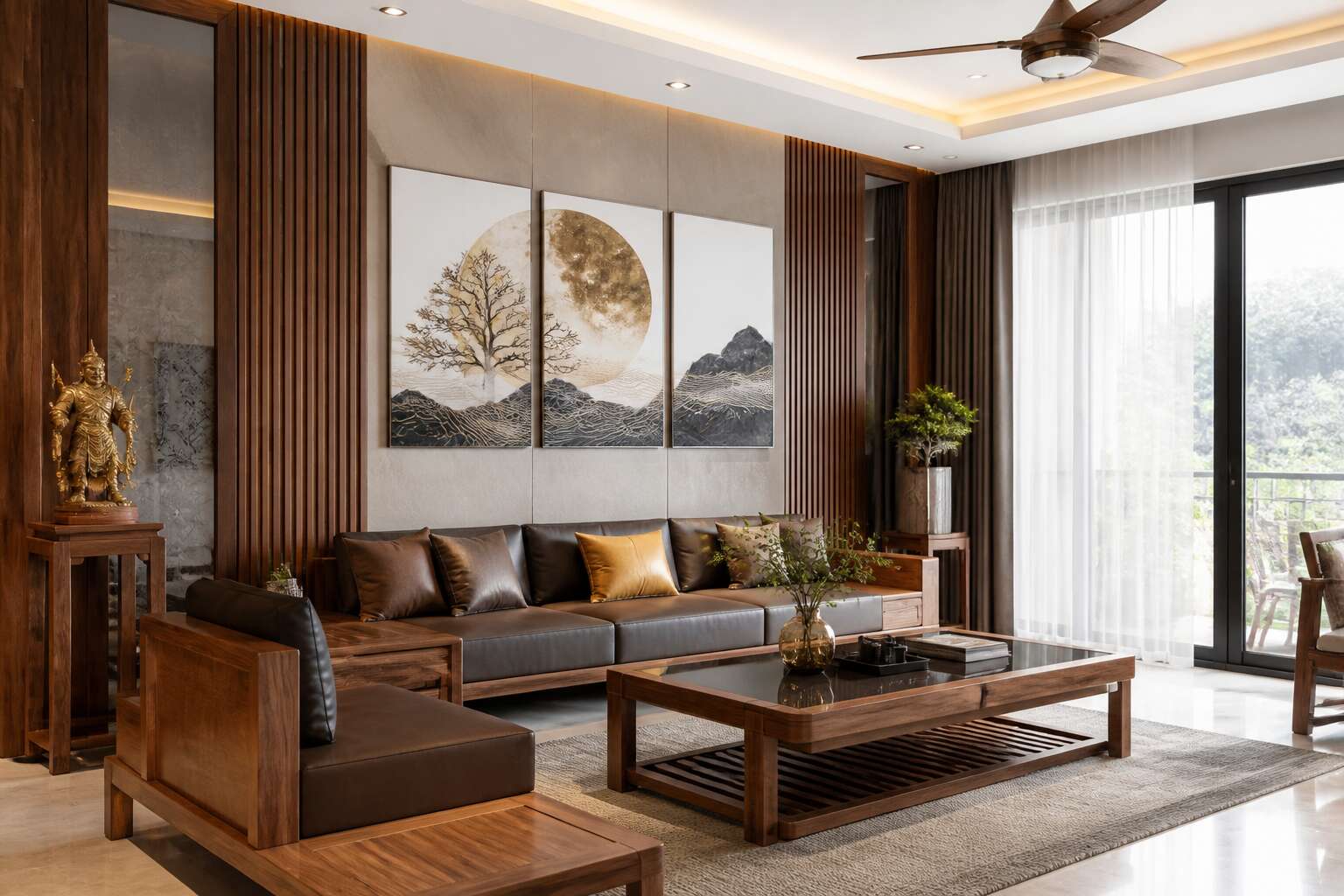
Why Wall Decor Matters in Architectural Visualization
Establishing Mood and Atmosphere Through Wall Elements
Viewers decide within seconds whether a rendered room feels real. The walls influence that decision more than any other element. Their texture, tone, and arrangement determine if a space feels welcoming or distant. For clients pursuing the American Dream, choosing the right wall decor lumionvietnam is the first step toward making a house feel like a home.
Atmosphere emerges from these deliberate choices in wall elements. A rough plaster finish suggests rustic warmth, while clean panelling projects order and calm. Such details produce an emotional response without a single word.
In architectural visualisation, wall elements serve several purposes:
- they define the scale of a room
- they establish the colour story
- they provide visual balance
Each decision, from trim to artwork, builds the lived-in quality that clients respond to. That is why wall decor lumionvietnam matters when setting the final atmosphere.
Wall Decor as a Focal Point in Interior Renderings
Walk into any interior rendering and your eye will search for a place to rest. That place is often the wall decor lumionvietnam. In architectural visualization, wall decor acts as the visual anchor, guiding the viewer through the composition and giving the digital space a clear point of focus.
Consider how the eye behaves when a wall is left bare. The gaze wanders without direction, and the render loses its hierarchy. A deliberate arrangement of art or sculptural elements changes that entirely. It creates scale, provides contrast, and gives the room a reason to exist.
- Focal decor defines the intended function of the space
- It offers a reference point for judging the size of the room
- It anchors the overall visual balance of the frame
Without that anchor, even flawless lighting and realistic materials fall flat. A single well placed piece of wall decor lumionvietnam transforms a sterile 3D model into a space that feels complete and intentional.
The Connection Between Wall Decor and Spatial Perception
The human eye interprets spatial depth through contrast and interruption. Blank walls compress a rendering, making rooms feel smaller than they are. Wall decor lumionvietnam introduces those interruptions, giving each surface a discernible distance.
A carefully placed canvas or sculptural piece lets the viewer gauge proportions without conscious effort. In architectural visualization, this matters more than geometric accuracy. The space must feel lived in.
- Decor gives vertical surfaces a reference for ceiling height.
- It clarifies the gap between foreground and background.
- It turns a bare interior into a credible living space.
Whether the setting is a Johannesburg loft or a Cape Town villa, wall decor lumionvietnam does the quiet lifting of making spatial perception effortless.
Trending Wall Decor Styles to Showcase in 3D Interiors
Minimalist Wall Treatments for Clean Aesthetics
Some designers treat walls as blank canvases, but 2025 trends are rewriting that script. Texture is the quiet rebel here, with limewash finishes and woven panels replacing flat paint in 3D interiors. These surfaces catch light differently at every angle, which matters when you are staging a render for a client. The result feels tactile, almost alive. Minimalism still rules, but it has grown warmer. Think less bare white, more tonal layering with subtle shadow play.
Consider what belongs in a clean aesthetic:
– Fluted wood slats that soften acoustics and sightlines
– Integrated shelving with no visible hardware for a seamless look
– Matte stone veneers that hold depth without shouting
Wall decor lumionvietnam workflows thrive on this balance. The best compositions avoid clutter yet never feel sterile, which is precisely where thoughtful 3D staging earns its keep.
Industrial Textures and Exposed Brick Finishes
Industrial textures are enjoying renewed attention in 2025 renderings. Exposed brick, once reserved for converted warehouses in Johannesburg, now appears in high-end residential visualisations. The trick lies in restraint. A single brick feature wall can anchor a living scene, while full brick wraps risk visual noise.
What makes these finishes work well in wall decor lumionvietnam workflows? The material editor handles the irregular surface of brick with surprising fidelity. Rough plaster and patinated concrete behave similarly. They scatter light in ways that reveal render quality, and I find that subtlety sells the scene.
- Honed concrete panels with visible aggregate
- Reclaimed brick with uneven mortar lines
- Oxidised metal sheets as industrial accents
Pairing these textures with softer elements keeps spaces habitable. Warm timber or linen softens the raw edges. That contrast reads immediately, which is why wall decor lumionvietnam projects lean into this balance.
Luxury Paneling and Classic Molding Details
Luxury paneling has returned to the render suite, and it carries a peculiar weight. In wall decor lumionvietnam scenes, fluted oak and ribbed walnut introduce shadows that shift with the sun. The moulding details whisper of older houses, of Cape Town’s Victorian verandas, though rendered with modern precision. I find the recessed panels create a rhythm, a cadence that steadies the eye before the furniture takes over.
Classic moulding profiles in 3D interiors have grown bolder, but they still demand patience. A single dentil row appears as a ghost of hand-carved labour. The material editor reproduces the subtle undercuts faithfully, and wall decor lumionvietnam thrives on that restraint.
- Fluted timber panels with grain matched across the face
- Geometric inlay borders in brass or ebonised wood
- Deep beading and recessed picture rails
The rendering tolerates no shortcuts in this work. Each edge must carry its shadow!
Biophilic and Eco-Conscious Wall Installations
In Cape Town, three in four property briefs now ask for nature inside the render. That shift changes wall decor lumionvietnam from a static backdrop to a living surface. Vertical gardens and preserved moss panels appear in living rooms, hotel lobbies, even wine bars. The 3D artist must render every leaf with patience. The green wall changes how a room feels. It draws the viewer closer and challenges the boundary between outside and inside.
Recycled timber battens and sisal panels offer another route, showing grain that has weathered naturally.
For the eco-conscious client, the render should show signs of weather: a knothole, a warp, a faint stain of rain. These imperfections convey honesty in wall decor lumionvietnam.
- Preserved reindeer moss in muted greens
- Reclaimed teak slats with visible nail holes
- Hemp fibre panels with irregular weave
Each installation demands that light behave as it would in nature.
Statement Artwork and Sculptural Wall Features
Statement artwork has moved beyond the frame. A three dimensional relief or a cascading textile changes the wall’s geometry, casting shadows that move with daylight. I’ve seen how wall decor lumionvietnam captures those shifts when the artist studies each angle. Texture becomes the main character, not the canvas.
Sculptural features reward close viewing:
- Layered wood slats bending away from the surface
- Hand formed plaster waves catching highlights
- Woven rope panels with intentional gaps
Each piece demands precise lighting. Reflections across irregular surfaces reveal the work’s true depth. Minimal frames and hidden fixings let the structure speak. That honesty fits modern South African interiors, where bold forms meet practical living. Wall decor lumionvietnam thrives when artwork feels structural, not decorative.
Maximizing Lumion Software for Wall Decor Visualization
Utilizing Lumion’s Material and Texture Libraries
A wall in a rendering is only as convincing as the surface you give it. The material libraries in Lumion hold the key to moving beyond flat, generic colors. For any project involving wall decor lumionvietnam, the texture choice becomes the silent storyteller of the entire space. You can spend hours perfecting a decorative feature, but if the surrounding plaster looks waxy or the timber grain is scaled incorrectly, the illusion breaks.
Using the software’s layered material system allows you to build depth. A single wall might combine a robust base texture with a subtle overlay of grime or a soft sheen. This is where the real value lies for a designer. None of the preset materials should be used as-is. Instead, pull the roughness slider down a little for a surface that catches light naturally, or increase the reflection map slightly for that faint, lived-in quality.
To get the most from your workflow, understand how Lumion treats physical properties.
– The displacement slider adds real geometric depth, which is perfect for stone or brick.
– Bump maps simulate surface irregularities without slowing down the render.
– Ambient occlusion within the material settings grounds the decor against the wall.
These elements, when adjusted together, produce a tactile quality. It is the difference between a picture of a house and a memory of coming home. For a render to feel honest, the walls must carry the same wear and imperfection we see in our daily lives. Paying attention to these minute details will transform a simple visualisation into a space with an authentic soul.
Lighting Strategies to Accentuate Wall Decor
Light is the only element that turns a flat wall into a living surface. In a render, luminance and shadow decide whether a panel reads as carved stone or flat grey. For wall decor lumionvietnam, the lighting strategy must come before the camera angle. A warm spotlight at a grazing angle reveals texture that no material setting can achieve.
Use Lumion’s area lights to create a soft wash across the surface. A narrow beam, positioned close to the wall, casts long shadows that define each ridge. For larger installations, a three-point approach works well:
- A key light to establish the primary shape.
- A fill light at low intensity to soften harsh contrast.
- A rim light behind the decor to separate it from the background.
Adjust colour temperature to match the room’s mood. Cool light suits modern pieces, while warm tones add a lived-in quality. The goal is to let the light reveal the wall’s character. In every wall decor lumionvietnam project, shadows give the decor its presence.
Model Import and Placement Workflows for Wall Pieces
Nearly half of a Lumion session can vanish into repositioning wall pieces that refuse to cooperate. For wall decor lumionvietnam, the import workflow determines everything. I always check the model’s origin before importing, because a rogue pivot point sends decor floating off target.
The placement workflow becomes a matter of centimetres. Here is the sequence I trust:
- Set the wall plane as the active snap reference.
- Import the decor piece at zero rotation.
- Adjust the elevation with a numeric input.
- Lock the axis to prevent sideways drift.
That approach keeps every piece flush. For wall decor lumionvietnam, the difference between a clean render and a floating disaster is this simple discipline. It saves time, spares your sanity, and makes the model behave.
Fine-Tuning Cameras for Wall Decor Close-Ups
Camera placement determines whether the render shows a piece of wall decor or a lived-in space. For wall decor lumionvietnam, a close-up reveals grain, shadow, and the quiet geometry of a surface. I adjust the focal length to compress the background so the decor carries the frame. Aperture needs a deliberate hand; too open and the detail blurs, too closed and the wall loses its texture.
A shallow depth of field works when the decor has dimension. For flat pieces, I pull the camera back a touch and rely on angle instead. The camera should sit at a respectful distance, not hover two centimetres from the surface. The focal length also determines how the surrounding wall reads; a wide lens bends the verticals, which spoils the clean line of a panel.
The settings that carry the most weight here:
– Focal length between 35mm and 50mm for natural perspective
– Aperture around f/2.8 for isolation
– Camera height matching the wall art’s midpoint
These settings keep the visual honest. For wall decor lumionvietnam, the render then reads as a space, not a slideshow.
Render Quality Settings for Detailed Wall Surfaces
For detailed wall surfaces, Lumion’s render quality settings decide how much of a material’s true character survives the export. wall decor lumionvietnam depends on these sliders more than people expect. I raise the reflection quality and keep the interior resolution at its higher threshold. A plaster finish then holds its grain instead of reading as a smooth, empty screen.
The render quality slider from draft to final changes how the wall responds to indirect light. I let the global illumination settle with enough passes so the decor sits on a surface with depth. For wall decor lumionvietnam, the settings are the difference between a wall you believe and a wall you tolerate.
What Lumion Vietnam Offers for Wall Decor Projects
A Look at Lumion Vietnam’s Visualization Process
Architects in South Africa often struggle to communicate wall decor intent. Lumion Vietnam’s visualization process handles that. Their wall decor lumionvietnam workflow starts with a conversation. You describe the room, the wall treatment, the light. They respond with a draft render within days!
What Lumion Vietnam offers is a disciplined pipeline. They build geometry, then refine surfaces, then place decor elements. The process avoids guesswork. For wall decor lumionvietnam projects, their team checks every piece against the camera angle. You see exactly what the client will see.
Their visualization process is built around iteration. Early renders are rough. Later ones get sharper. The loop is simple:
- Send your floor plan and wall measurements.
- Receive a base render with neutral tones.
- Review decor placement and surface choices.
- Get final images with varied lighting.
That loop saves time and money. It also gives you a shared reference point with contractors.
Translating Local Vietnamese Design Culture into Wall Decor
Vietnamese wall decor carries a quiet history. Hand painted ceramic tiles, woven rattan panels, and lacquered wood carvings tell stories of riverside towns and ancestral homes. Lumion Vietnam offers South African architects a direct path to these textures. Their wall decor lumionvietnam library includes authentic surface maps for aged plaster, mother of pearl inlay, and silk embroidery.
I have seen their team convert a single photograph of a Hanoi courtyard wall into a render material. The process takes hours, not weeks. For a Cape Town renovation, this means you can place Vietnamese cultural details into a local interior without losing context.
- Woven bamboo screens with natural shadow depth
- Glazed ceramic tiles with irregular kiln tones
- Carved wooden panels with visible tool marks
Their wall decor lumionvietnam workflow pairs each texture with real world scale. A rough plaster finish reads properly under South African sunlight. That cultural translation gives your project a grounded, specific identity.
Collaboration Workflows for Interior Designers and Architects
Collaboration workflows often fail due to file formats and mismatched expectations. Wall decor lumionvietnam simplifies that handoff. Designers share a texture library with architects who need to verify how a bamboo panel behaves under afternoon glare. Lumion Vietnam provides a shared material palette that both sides can trust.
The workflow breaks down into three steps:
1. Designers select a texture from the wall decor lumionvietnam library.
2. Lumion Vietnam maps it to real world dimensions.
3. Architects drop it into the scene and adjust lighting without rework.
This direct pipeline saves hours. One Cape Town firm tested four wall finishes in a single morning using this method. The client chose the third option, and the project moved forward without a single redraw.
Case Study: Residential Wall Decor Project by Lumion Vietnam
Most residential renderings fail at the wall. For a recent Cape Town home, our team used wall decor lumionvietnam to test four finishes before the client saw a physical sample. The difference was the material data. Lumion Vietnam maps every texture to real dimensions and confirms how it reacts to specific daylight conditions.
We loaded a clay plaster, a teak slat system, a woven fibre panel, and a painted canvas texture. The teak slat system from wall decor lumionvietnam held its colour under the afternoon glare. The fibre panel shifted too warm. The client picked the teak within forty minutes.
- Accurate grain and reflection for residential walls
- Texture library suited to local South African light
- Direct import without scale adjustments
That speed saved a full design iteration. The approval was unanimous, and the construction drawing set required no changes. It was the simplest wall decision we have managed this year!
Cost and Timeline Expectations for Wall Decor Renders
Most South African clients assume a wall decor render costs the same as a standard interior view. It does not. wall decor lumionvietnam packages each material test as a separate deliverable. For a single wall, expect a starting rate around R4,500. A full interior with three distinct wall treatments runs between R12,000 and R18,000. Timeline expectations follow the same logic. A straightforward teak slat or plaster finish takes three working days. Layered installations, such as sculptural panels with integrated lighting, push that to five.
The process breaks down into stages:
- Material mapping and scale verification
- Daylight simulation across morning and afternoon angles
- Two revision rounds for finish selection
That structure keeps costs predictable! No hidden fees for texture libraries because wall decor lumionvietnam builds each material from real product data. You pay for the clarity, not the clock. Last quarter, our Cape Town studio delivered a hotel lobby wall concept in six days flat. The client approved without a single physical sample.
Client Feedback and Portfolio Highlights
South African clients rarely expect their first wall decor lumionvietnam render to survive contact with the design committee. Ours do. A Pretoria architecture firm recently approved a sculptural plaster wall for a retirement village lounge after a single revision, then ordered three more renders for sister branches.
Portfolio highlights follow a pattern:
– Residential feature walls with handmade clay tiles
– Hospitality installations combining wood slats with fabric panels
– Retail displays needing sharp morning to evening daylight shifts
Client feedback keeps returning to one point. Our renders reduce phone calls. Builders stop guessing, suppliers stop substituting, and the design intent stays intact. That clarity has made wall decor lumionvietnam a recurring name in Cape Town and Johannesburg studio referrals.
Emerging Trends Shaping Wall Decor and 3D Rendering
The Rise of Real-Time Rendering for Interior Design
Real-time rendering has changed how designers in South Africa present wall decor lumionvietnam. The old days of waiting hours for a single frame are gone. Now, clients can watch light move across a textured surface while they speak. It feels like standing in the room itself, not a drawing of one.
This immediacy shapes decisions. A client sees a paneled wall at dusk, with shadows pooling in the grooves, and they understand the material’s weight. No explanation required. The technology removes guesswork from the design process.
Some emerging trends worth noting:
- Interactive material swapping during live walkthroughs
- Physical based lighting for accurate wall reflections
- Cloud collaboration for remote design reviews
These tools let us explore wall decor lumionvietnam in real time, uncovering flaws before construction begins. The render becomes a conversation partner, not a final statement. For South African interiors, this means bolder choices, tested before they become permanent.
Integrating Virtual Reality for Wall Decor Presentations
Virtual reality is becoming the benchmark for reviewing wall decor lumionvietnam scenes. A Johannesburg client puts on a headset and steps toward a textured feature wall. The reaction is immediate. Scale reads true. Texture feels present. I have watched clients reach out to touch a render. That instinct tells me more than any survey ever could.
The emerging trends are precise:
- Photogrammetry captures handcrafted panels and woven surfaces with exact displacement
- Real-time sun studies track shadow movement across plasterwork
- Hand-tracking tools allow artwork repositioning inside the virtual room
For South African studios, wall decor lumionvietnam becomes a testable object, not a static image. Clients leave the headset with opinions shaped by something close to reality. The render was always a guess. Now it is evidence!
Sustainable Materials and Their Realistic Representation
Every client claims to love sustainable materials until they see what recycled grain board actually looks like in a render. The gap between eco-ambition and pixel is shrinking. Wall decor lumionvietnam now tackles the uncomfortable part of green design: imperfection.
Recycled timber brings nail holes, char marks, and grain shifts. Mycelium panels have edges that refuse to tile cleanly. Hempcrete scatters light like a sponge, not a wall. I have watched presenters call a sepia filter “weathered”. Rendering these surfaces truthfully takes work.
- Subsurface scattering for bio-based boards
- Displacement data from real waste materials
- Wear layers that show actual decades of use
South African clients respond to that honesty. They have endured too many sterile nature renders. When wall decor lumionvietnam looks authentically worn, the design earns trust without a single claim.



0 Comments