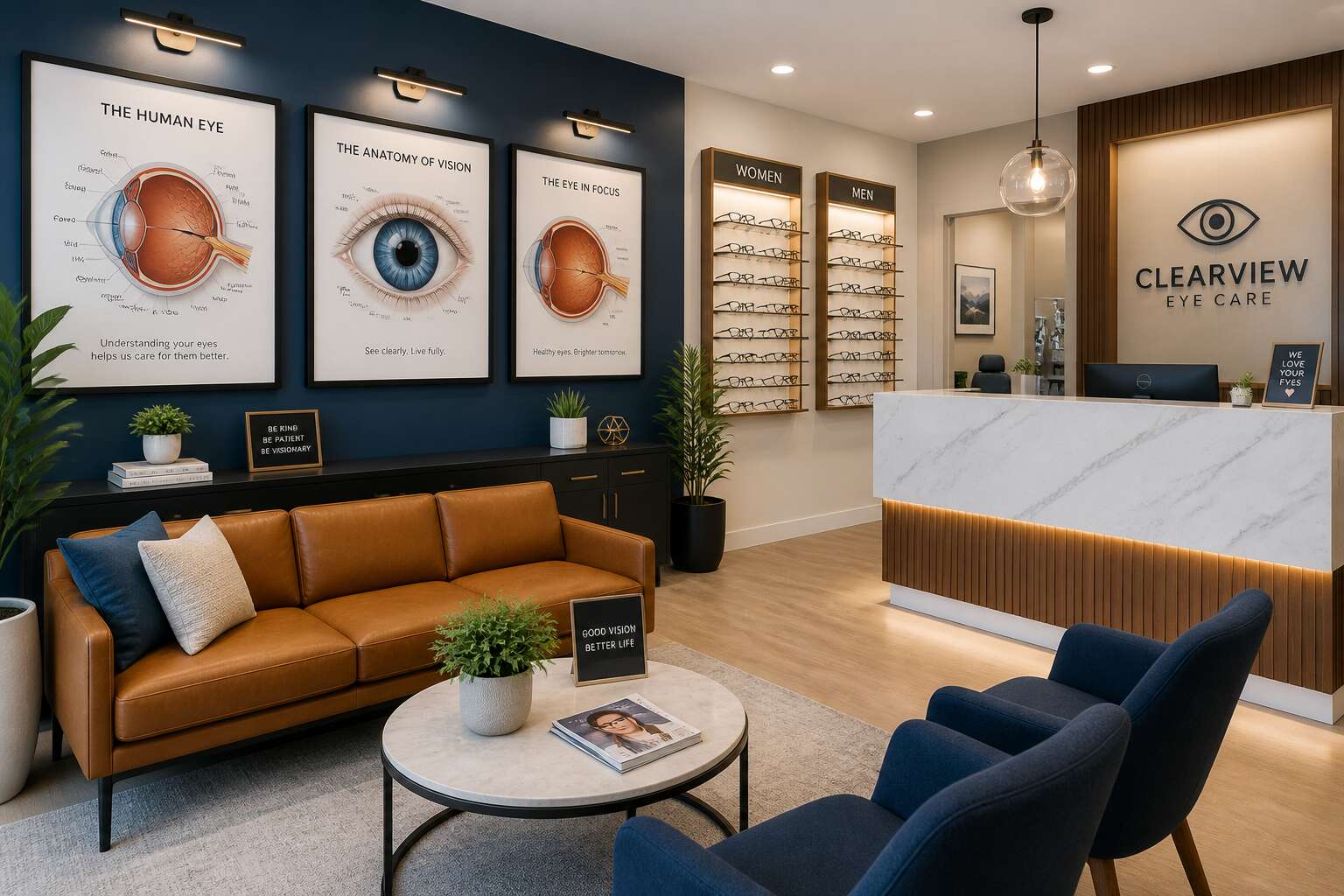
Designing a Welcoming Optometry Waiting Room
Using Color Psychology to Create a Calm Atmosphere
The moment a patient steps through the door, the visual environment begins to shape their experience. Soft blues and muted greens are known to slow the pulse and reduce anxiety, making them reliable foundations for a calm atmosphere. Warm neutrals, such as sand and stone, add a grounded feel without overstimulating the senses.
Choosing the right shades for optometry office wall decor requires attention to both hue and saturation. Pale tones reflect light gently, while overly bright accents can create visual noise. I always advise practices to use color as a quiet guide, leading the eye from the entrance toward the seating area. A subtle palette also keeps the focus on the clinical work ahead.
- Dusty blue for a sense of stability
- Sage green to encourage relaxation
- Soft grey to balance warmth and neutrality
These colors perform best when paired with natural textures and diffuse lighting. In waiting rooms, the goal is to prepare the mind for a thorough eye examination. Thoughtful optometry office wall decor turns a mundane interval into a moment of mental rest.
Integrating Vision-Themed Wall Decals and Murals
Most patients will stare at your waiting room walls longer than they will look at your equipment. Vision-themed wall decals and murals turn that idle gaze into something meaningful. Eye charts, oversized spectacles, and abstract iris illustrations create a visual language that feels familiar and welcoming. This is optometry office wall decor with a clear purpose.
A mural of a landscape seen through a lens can make a small room feel more open. Decals can direct movement, framing the reception desk or guiding patients toward the seating area. The clinical space feels less intimidating when the walls tell a story.
For a cohesive design:
– Match decal hues to the existing furniture
– Keep the scale proportional to the room size
– Position artwork where it is visible from every seat
Patients arrive anxious and leave with a memory of the clever eye chart on the wall. That is the mark of optometry office wall decor done right.
Balancing Aesthetic Appeal with Practical Durability
I have watched beautiful clinics undone by a single peeling corner. Patients notice a chipped wall before they register the furniture. The South African waiting room faces punishing sun, coastal humidity, and harsh disinfectants.
Practical optometry office wall decor starts with the substrate. Specify washable vinyl, rigid PVC sheeting, or high pressure laminate in high traffic zones. These materials handle the daily wipe down and keep the aesthetic intact for years. Ask for anti-graffiti coatings. They simplify maintenance without changing the look.
- Test your actual disinfectant on a sample panel
- Verify the fire rating required by your local municipality
- Choose UV stabilised pigments for sun exposed walls
Durability does not demand a sterile look. Deep, textured finishes and sealed woven panels add warmth while surviving constant contact. The result is optometry office wall decor that endures daily use and still feels human.
Wall Decor Strategies for Eye Exam Rooms
Selecting High-Contrast Art for Visual Testing
A patient’s contrast sensitivity can erode by half before a standard acuity chart registers a change. This is why high-contrast art plays a clinical role. When you hang optometry office wall decor, you are building a diagnostic environment. Avoid soft pastels or gradients. They wash out under dim illumination. Select black on white or pure red on black. These disrupt the visual cortex and force accommodation.
- Thick black and white checkerboards to test spatial resolution
- Vertical sine-wave gratings to stimulate contrast sensitivity
- High-frequency stripes to expose astigmatic errors
The placement matters. Position art at the patient’s fixation point, roughly two meters away. That turns decoration into a functional tool. During refraction, the patient’s eye will seek edges. If your optometry office wall decor offers those edges, you are running a dynamic test. Keep lighting adjustable to control glare, since contrast is only valid when luminance is consistent. This quiet strategy yields loud results.
Educational Anatomy Charts as Functional Decor
In an exam room, walls serve a purpose. Educational anatomy charts turn blank space into patient education tools. A labelled cross section of the human eye, placed where a patient sits, prompts questions that a standard chart cannot answer.
Patients connect their symptoms to structures when they see the vitreous humour, the retina, and the optic nerve. The optometry office wall decor links clinical terminology to lived experience.
- Label the layers of the cornea
- Show the pathway of light through the lens
- Illustrate the macula and its role in central vision
Position these charts at eye level in the consultation room. South African practices often serve diverse language communities, so visual reference points carry real weight. Optometry office wall decor earns its place by teaching while you test.
Backlit Eye Charts That Double as Light Sources
Stage 6 load shedding leaves you squinting at a dead chart. A backlit eye chart doubles as a light source for the room. Optometry office wall decor that glows keeps the consult space usable when the grid fails.
The luminance from these panels mimics standard daylight, preventing shadowing and squinting. You get a consistent test environment regardless of the hour.
Before you mount one, consider:
- Dimmable settings to avoid blinding a patient after dilation.
- Colour temperature around 5000K for accurate perception.
This dual-purpose fixture discards the floor lamp and frees up space.
Framed Patient Education Materials for Clarity
When patients settle into the exam chair, they often stare at the same wall for several minutes. Framed patient education materials turn that idle gaze into a quiet learning experience. A clear diagram of cataract progression or an illustration of glaucoma gives patients visual context before the optometrist begins speaking.
Good framing determines how long these materials remain useful. Slim aluminium frames with non-reflective glass prevent glare under clinical lighting. Mounted at eye level across from the patient chair, the pieces invite study without straining. In this way, optometry office wall decor fulfils a practical role in the room.
The most effective framed items share certain qualities:
- Large illustrations over dense paragraphs
- Anatomically accurate artwork that matches current teaching
- Colour reproduction legible from two metres away
Patients often point at a framed diagram during follow-up questions. That simple interaction saves time and builds trust.
Minimizing Visual Clutter to Improve Focus
Patients spend an average of 12 minutes staring at exam room walls before the optometrist arrives. A wall crammed with posters, certificates, and faded price lists sends one signal: chaos. Visual clutter directly competes with the task at hand, which is examining the eye.
For optometry office wall decor, restraint is the strategy. One carefully chosen piece per wall beats a crowded display. The sightline from the patient chair stays clear. If the wall carries too much, the patient’s gaze bounces around instead of settling.
Consider these rules of thumb:
- Limit each wall to one functional decor item.
- Keep the area around the acuity chart completely bare.
- Remove any signage with outdated information.
Uncluttered wall decor respects the patient’s attention. The exam room is a workspace where clear walls support clear assessments.
Custom Wall Art That Reflects Your Practice Brand
Your exam room walls should reflect your brand with restraint. Custom wall art offers a chance to embed identity into a clinical space. A single, well executed piece with your practice logo or a stylised optical mark can define the room.
For optometry office wall decor, custom art works best when it respects the room’s primary purpose. The patient’s gaze must settle on your equipment and charts, not compete with additional visuals. Choose a piece that is bold enough to be memorable, yet subtle enough to remain unobtrusive during an examination.
- Use a matte finish to avoid glare
- Position art on the wall opposite the acuity chart
- Keep the frame simple and flush to the wall
I have found that patients often comment on a custom piece that reflects the practice’s values, especially when it features local South African imagery. That connection builds trust before the first test begins.
Merging Optical Retail Displays with Wall Decor
Accent Walls That Highlight Eyewear Collections
In Pretoria, patients spend 12 minutes waiting for their appointment. That’s time to browse your frames. Merging optical retail displays with optometry office wall decor accent walls that highlight eyewear collections turns that waiting into a self guided shopping trip. Paint a single wall in matte oxblood, then mount three floating shelves at staggered heights. Each shelf displays one frame style, like aviators or round wire frames.
- Add a mirror opposite the wall for quick self checks.
- Use track lighting to spotlight each shelf.
- Keep the base colour neutral to highlight frame colours.
This approach eliminates bulky floor stands. Your optometry office wall decor then doubles as display and sales tool. For smaller practices in Durban, it saves valuable floor space.
Wall-Mounted Shelving and Frame Displays
The waiting room holds its breath. Wall mounted shelving transforms a passive wall into a quiet commerce of frames. In Pretoria, patients spend twelve minutes staring. That is time to touch and try. Each shelf displays a single frame style, a small cathedral of acetate and wire. A mirror opposite catches the self conscious glance. Track lighting carves each object out of shadow.
This optometry office wall decor eliminates bulky floor stands. It saves space for smaller practices in Durban, where every square metre carries cost. The base colour remains neutral, so the frames bleed their hues into the room. Arrangement demands rhythm:
- Round wire frames at eye level
- Aviators slightly lower
- Browline silhouettes near the top
Staggered heights force the gaze to wander. This optometry office wall decor becomes a quiet salesperson, patient and wordless.
Branded Signage Blended with Decorative Elements
Your practice logo is not a relic to hang on a wall and forget. Merging optical retail displays with wall decor means branded signage has a job to do. In Johannesburg, a backlit sign above the frame display does more than state your name; it creates a focal point.
Blend signage with decorative elements by giving your brand a supporting role. Choose:
- Metal letters on a textured wood panel
- A logo integrated into a geometric light fixture
- A hand painted monogram on a slate wall
This optometry office wall decor feels intentional, not corporate. Patients notice the sign, then the frames, then the room. The space works harder without shouting.
Seasonal Decor to Refresh the Retail Area
Seasonal decor gives an optometry office wall decor plan a reason to change. When winter light shifts in Johannesburg, swap bright summer prints for warmer tones that match the frame displays. A small shelf of autumn-toned accessories beside the trial lenses can refresh the retail area without overwhelming patients.
Consider rotating a few pieces:
- Seasonal colour palettes in framed prints
- Lightweight fabric wall hangings that mirror the eyewear collection
- Small potted plants that follow the growth cycle
Each change keeps the space familiar yet new. Patients returning for annual eye exams notice the difference. The optometry office wall decor stays relevant, and the retail displays gain a quiet energy that shifts with the calendar.
Practical Considerations for Durable and Cleanable Decor
Choosing Easy-to-Clean Materials for Medical Environments
Reception walls in a medical practice endure constant handling, from patient elbows to curious fingers. A single smudge on an optometry office wall decor piece can undermine the hygiene message you work hard to convey. That is why surface selection matters as much as visual appeal.
Consider materials that tolerate repeated disinfection without fading. High pressure laminate, powder coated metal, and sealed acrylic are dependable choices. Each resists moisture and cleans with a simple wipe.
- Anti-bacterial vinyl wraps
- Glass with tempered coating
- Solid surface panels
I always advise asking suppliers for cleanability test results. Porous textures and unsealed wood invite grime, so skip those in high traffic zones. Your wall decor will stay bright and professional for years!
Moisture-Resistant Options for Sterilization Zones
Steam, spray, and the relentless assault of hospital-grade disinfectants turn pretty surfaces into peeling disasters. When you select optometry office wall decor for a sterilization zone, you need materials engineered for brutal resilience. I have seen gorgeous framed prints meet their demise within three weeks of installation near a lens cleaning unit!
- Solid polyester panels that resist water penetration.
- Aluminium composite sheets with a UV-stable coating.
- Sealed acrylic sheets that withstand splashes.
These surfaces handle constant wiping without ghosting or warping. Matte paper finishes are a poor choice in areas with persistent moisture or splashes. In South Africa, coastal humidity adds another layer of stress, so corrosion resistance of any metal fixture becomes critical.
Fire-Retardant and Safety Compliance Standards
Fire-retardant and safety compliance standards are the unglamorous necessity of any professional space. In South Africa, SABS approved materials with a Class 1 fire rating are a mandatory baseline for your optometry office wall decor. Pair that with cleanable surfaces that endure daily disinfectant wipes.
The practical factors are:
- Sealed seams prevent moisture ingress behind the panel.
- Non-porous surfaces resist bacterial growth.
- Aluminium composite sheets offer structural rigidity without extra weight.
A wipe-clean matte laminate finish looks soft but fails against a semi-gloss acrylic in routine scrubbing. The trade-off between aesthetics and compliance is minimal. Your choice should clear the fire inspector’s checklist and the cleaner’s bucket.
Budget-Friendly DIY Decor Solutions
The real cost of optometry office wall decor appears in maintenance hours, not invoices. A panel that looks striking on day one but stains by week three wastes your team’s time. I have seen practices spend more on cleaning chemicals than on the artwork itself.
For tighter budgets, consider these approaches:
- Wallpaper panels in high traffic zones. They are simple to replace and forgiving under constant handling.
- Removable vinyl sheets cut to size. They install without professional help and peel off cleanly for seasonal changes.
- Tension rod displays for framed patient education cards, which allow quick swaps.
DIY solutions require the same forethought as expensive installations. Prepare the wall surface properly, keep seams away from direct light, and test one small section before committing. A modest setup, chosen with care, often outperforms elaborate optometry office wall decor that nobody dares to touch.
Hiring an Interior Designer vs. In-House Implementation
In Durban’s coastal humidity, the true test of optometry office wall decor is how it survives repeated cleaning. I have watched practices scrap beautiful panels because the finish peeled under daily disinfectant contact.
Hiring an interior designer often secures commercial grade, cleanable surfaces, but you still need a maintenance schedule. In-house implementation lets you experiment with practical materials, yet demands careful prep.
- Request a written care guide from any designer.
- Try one wall section with your chosen cleaner.
Either route works if you avoid porous textures. Durable, wipeable options reduce replacement costs and keep your space professional for years!
Enhancing Patient Experience Through Thoughtful Wall Art
Nature-Inspired Murals to Reduce Anxiety
Imagine a patient settling into the exam chair, their gaze falling on a mural of a misty forest instead of a blank white wall. A 2021 study in Frontiers in Psychology found that nature scenes lower heart rate and anxiety. For a South African optometry practice, this means calmer patients and smoother examinations.
Nature-inspired murals do more than fill space. They connect patients to the outdoors, which is valuable in windowless rooms! Choose scenes with depth, such as winding paths or distant horizons, to create openness. The best optometry office wall decor combines this calm with the need for low glare finishes.
When planning a mural, keep these elements in mind:
- Muted botanical tones that complement your existing palette
- Soft focus elements to avoid competing with visual tests
- Large scale compositions that read clearly from a distance
The result is a space that feels less clinical without losing professional credibility.
Building Trust with Professional Yet Warm Design
Patients notice details. The optometry office wall decor tells them whether you run a clinical operation or a practice that sees them as people. A framed local artwork or a curated gallery wall shifts the mood from sterile to welcoming without losing professional credibility. That first impression shapes how they hear everything else you say.
Consider these principles when choosing pieces:
- Select works that reflect the community, like Cape Town street scenes or Karoo landscapes
- Frame everything uniformly to signal order and attention to detail
- Leave negative space around art to keep the room from feeling crowded
Trust builds through consistency. If your reception area shows abstract prints but your exam room has bare walls, patients notice the mismatch. Thoughtful optometry office wall decor carries warmth from the front desk to the last room. That continuity reassures them that the same care applies to their eyes.
Creating Instagram-Worthy Backdrops for Social Sharing
Patients photograph what moves them. The right optometry office wall decor creates that moment of pause. A striking piece, framed by warm lighting, turns a routine visit into a shareable snapshot. That photo, posted to Instagram, carries your practice into networks you could never reach through paid ads alone.
- Choose art with bold shapes and clear focal points
- Keep the background free of clutter and signage
- Position seating so patients can frame themselves naturally
Consider the South African eye. A local township skyline or a minimalist line drawing of Table Mountain resonates deeper than generic prints. When patients tag your location, their followers see a practice with personality. Optometry office wall decor that photographs well serves two purposes: it elevates the room and markets the brand. That is engagement that keeps working long after the appointment ends!
Sourcing and Installing Optometry-Specific Decor
Where to Buy Medical-Themed Wall Art
Most practice owners spend more time choosing a reception desk than they do on the walls behind it. Sourcing optometry office wall decor in South Africa means moving beyond generic stock prints. Local medical supply catalogues often list sterile landscapes, while specialized print houses in Johannesburg and Cape Town offer anatomical diagrams printed on brushed aluminium or canvas. I found that visiting a trade show like the South African Vision Expo gives you direct access to suppliers who understand clinical settings.
For installation, consider the sightline of a seated patient. Mount frames at eye level, roughly 150 centimetres from the floor. Use anti-reflective glass to maintain visibility under fluorescent lighting. Where to buy medical-themed wall art often comes down to three reliable channels:
- Optometrist associations’ bulk order programs
- Independent framing studios that print on demand
- Online platforms with a local shipping filter
Ensure hanging hardware is rated for the wall type, whether plaster or brick. A laser level keeps the rows precise. This approach turns your optometry office wall decor into a professional asset.
Custom Printing Options for Eye Care Practices
Custom printing gives eye care practices full control over scale and subject. A Johannesburg print studio can produce oversized retinal scans or stylized iris patterns on textured canvas. Request a physical proof before bulk ordering. Screen colours shift between devices, so inspect the final output under your clinic’s lighting.
Consider these fabrication routes for eye care practices:
- Dye sublimation on aluminium for scratch resistance
- Direct printing on Dibond composite panels
- Frameless acrylic with beveled edges for a clean profile
Installation depends on wall composition. A masonry bit is necessary for brick walls in older Cape Town buildings. Stand-off spacers keep aluminium prints off the surface. Edge-to-edge pieces need hidden mounting systems to preserve the clean frame line. Laser-cut acrylic letters embedded in the print surface create dimensional optometry office wall decor without additional framing.
Installation Tips for Large-Scale Artwork
Sourcing large pieces requires checking the print’s weight against your wall’s load capacity. A 2 metre aluminium print weighs more than a framed canvas of the same size. Ask your print studio for the exact kilogram figure before arranging installation. For optometry office wall decor, the mounting system matters as much as the image itself.
– Use a stud finder on drywall partitions common in newer medical suites.
– Specify stainless steel hardware for coastal regions like Durban, where humidity corrodes standard fittings.
– Request a second set of hands for anything above 1.5 metres wide.
Concrete walls in older Johannesburg buildings need a hammer drill with a masonry bit. Locate the reinforcing bars before drilling to avoid structural damage. Always keep the artwork level using a laser level, not a spirit level, for accuracy across long spans.
Partnering with Local Artists for Community Engagement
When we partner with a local painter for optometry office wall decor, the practice becomes part of the neighbourhood’s visual language. Artists bring their own materials and techniques, which means we must confirm the artwork’s weight and mounting needs before installation day. For a recent project in Cape Town, we worked with a ceramicist who created textured tiles that doubled as sight-line guides.
This collaboration offers more than aesthetics.
- Invite artists to speak at your practice’s open night.
- Feature their process on your social media.
- Co-host a workshop for children’s eye health.
Each engagement builds trust and reminds patients that their eye care provider values local creativity.




0 Comments