Defining Furniture and Wall Decor
The Traditional Definition of Furniture
A dining table holds your Sunday braai. A canvas holds only your attention. That difference fuels the debate over whether wall decor belongs in the furniture category. By traditional definition, furniture is movable and functional. It equips a room for living, from wardrobes to office desks. Wall decor, by contrast, is static and expressive. It decorates rather than equips.
Traditional furniture carries three defining traits:
- Portability around the room
- Support for human activity or storage
- Structural independence from the building
Wall decor fails these tests. A framed print is fixed to the wall and carries no physical load. So is wall decor furniture? Historically, no. Yet modern hybrid pieces, like floating bookshelves and decorative room dividers, complicate that clean split. The question “is wall decor furniture” still drives retail pricing, delivery logistics, and interior design decisions. Those old categories persist because the industry still organises its stock around them, even as the products themselves blur the boundary.
Key Characteristics of Wall Decor Pieces
Wall decor pieces share a few unmistakable traits. They mount to the wall, they carry no function beyond visual impact, and they rarely support anything heavier than a stray nail. A canvas print, a sculptural mirror, or a woven wall hanging all answer to the same brief: change the room’s mood without changing its layout.
- They stay fixed in place
- They serve the eye, not the body
- They borrow stability from the building
So where does that leave the question, is wall decor furniture? The answer gets cloudier with every product launch. Floating shelves hold books. Wall-mounted desks fold down for work. These pieces claim wall space yet perform furniture duties. That hybrid reality makes the old categories feel outdated.
Functional Differences Between Wall Decor and Furniture
Utility and Everyday Purpose
Most South African homes contain both a sofa and a painting, yet only one earns the label of furniture. I find the real difference in utility. Furniture holds, supports, stores, and seats. Wall decor changes how a room feels, not how it functions. One works with the body, the other works on perception.
When someone asks is wall decor furniture, daily routines provide the answer. We sit on chairs. We place cups on tables. We open drawers without thinking. No one leans on a picture frame.
Consider the measurable gaps:
- Furniture moves as needs change. Wall decor stays fixed.
- Furniture wears from use. Wall decor collects dust.
- Furniture supports the body. Wall decor supports mood.
A bookshelf holds books. A canvas holds attention. In daily use, the question of is wall decor furniture answers itself.
Storage, Seating, and Structural Roles
A bookshelf takes the weight of your library. A wall hanging takes nothing. That load bearing difference is the silent answer to is wall decor furniture. I once watched someone lean on a canvas. It shifted. It does not hold!
Consider the structural roles we demand from objects every day. A chair supports a body. A table supports a meal. A cabinet supports a collection. Wall decor supports none of these. It hangs, it frames, it colors the wall. But it never carries.
– No one sits on a framed print.
– No one stores dishes behind a tapestry.
– No one builds a room around a poster’s load capacity.
The question is wall decor furniture collapses when you ask what it supports. A shelf earns its place by holding. A picture earns its place by being looked at. That is not a minor distinction. It is the entire difference between function and ornament.
Permanence and Installation Considerations
The functional rift between a sideboard and a framed textile appears the moment you try to rearrange a room. Furniture flexes with your habits; wall decor remains fixed to its coordinates. That static nature sharpens the answer to is wall decor furniture: it never adapts to the room’s daily logic. It merely observes!
Installation deepens the divide. A mirror needs raw plugs and a spirit level, and reversing that decision leaves holes in your plaster. A wardrobe can be dragged to a new wall without a trace. This asymmetry matters when you rent or refurbish.
- Furniture adapts to changing layouts.
- Wall decor demands commitment before it contributes anything.
So when you ask is wall decor furniture, permanence alone answers no.
Design and Styling Perspectives
Layering Rooms With Decor vs. Furniture
Designing a room often starts with a simple question: is wall decor furniture? For styling purposes, the answer matters less than how each element contributes. Wall decor occupies vertical planes; furniture occupies horizontal ones. Their placement creates a visual structure!
I prefer to arrange pieces with intention:
- Hang a large piece behind a low console to connect the wall to the floor.
- Position a mirror opposite a window to reflect light across the room.
- Group small frames with a floor lamp to spread attention through the space.
These arrangements show that wall decor changes perception, while furniture changes utility. In a layered room, both work together. The distinction between them becomes part of the overall composition, which is the real goal of styling.
Visual Weight and the Role of Anchor Pieces
A room without visual weight feels unsettled. The question is wall decor furniture often misses this point. What matters is how a piece draws the eye and holds the space.
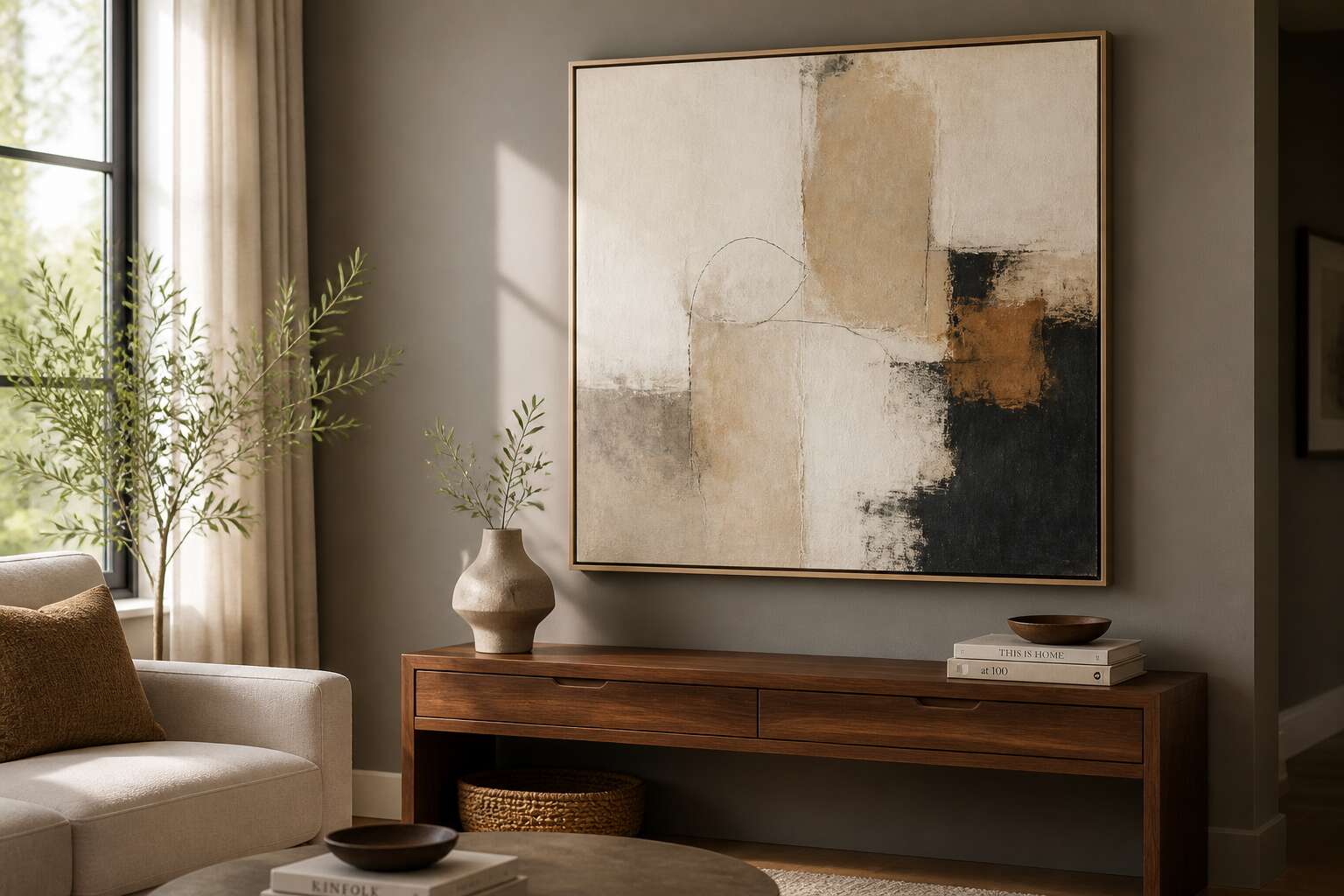
Anchor pieces do exactly that. A large artwork above a sideboard grounds the composition. It connects the vertical plane to the horizontal, giving the room a centre of gravity. Smaller items then relate to that anchor.
- A dark framed print adds depth to a light wall.
- A sculptural mirror can balance a heavy sofa.
- A grouped gallery wall creates rhythm across the surface.
These choices show that visual weight, not category, determines how a room feels.
How Interior Designers Categorize Wall Hangings
Interior designers rarely ask whether a piece belongs to a strict category. They categorize wall hangings by their spatial function. A large canvas becomes a focal anchor. A series of small prints works as a secondary rhythm. A woven textile softens a hard surface.
This is why the debate about is wall decor furniture feels academic. Designers assign wall hangings specific roles:
- Focal pieces that hold the eye
- Transitional pieces that connect separate zones
- Textural pieces that add depth
Each role changes how the piece is placed, sized, and lit. The label matters less than the effect on the room’s balance. That is the lens that shapes a composed interior.
The Emergence of Hybrid Decor-Furniture Items
Hybrid decor-furniture pieces are emerging from a simple need: make every surface perform. Design stylists in Johannesburg have shown me wall-mounted desks that fold into art frames. Others install narrow ledges beneath large canvases to hold candles or small ceramics. The question is wall decor furniture starts to dissolve when an object does both.
These items force a different way of seeing. A mirror becomes a display station. A woven panel becomes a room divider. A shelf becomes a frame for a curated collection.
- Folding wall desks with integrated storage
- Light fixtures with built-in display shelves
- Textile panels that absorb sound and separate zones
For compact South African homes, hybrid pieces offer an honest answer. They save floor space without sacrificing silhouette. That is a design win in any language!
Wall-Mounted Storage and Functional Art
Stylists in Cape Town no longer ask if a piece is wall decor furniture or pure storage. The design perspective views each mounted object as a compositional element. A floating credenza becomes a horizontal accent. A sculptural bracket holding one plant balances the wall’s negative space.
This thinking changes how we style shelves. Instead of filling them with clutter, we curate. A ledge at eye level holds a ceramic piece. Its shadow becomes the artwork, proving utility itself can be visual. I find that functional art rewards intentional placement.
- Ledge width dictates the scale of objects.
- Mount depth alters the wall’s perceived thickness.
- Bracket finish absorbs or reflects ambient light.
In a compact Johannesburg flat, this perspective turns a simple peg rail into a gallery. The question of whether a wall mount is wall decor furniture dissolves when the piece performs both roles with equal grace. Styling rests on the harmony between vessel and host surface.
Retail Classifications and Industry Standards
How Online Marketplaces Sort Wall Decor
Online marketplaces have their own classification logic. They sort wall decor under home accents, not furniture. I find this distinction revealing. It affects search filters and product feeds. Retail standards separate items by function and mounting. For example:
- Wall art and tapestries fall under decor
- Shelving units and wall desks appear in furniture
This taxonomy answers whether is wall decor furniture at the point of sale. The answer depends on utility. A floating shelf can be both, but marketplaces force a choice. Their algorithms prioritise categories that drive purchases. Shoppers searching for storage will find shelving under furniture, while purely decorative pieces stay in decor. This split reflects consumer intent and inventory management.
Home Furnishing Industry Categories
The dividing line between decor and furniture shifts the moment you walk into a South African lifestyle store. Retail classifications look at how an object behaves in a room, not how it looks. A mirror framed in solid oak occupies the wall like a window, yet it never supports weight or offers a surface. The same mirror in a hallway, propped against the skirting, becomes a leaning piece that functions more like a console. The question of is wall decor furniture often depends on the retailer’s merchandising plan, not the item’s physical form. Industry standards follow a simple rule: if it provides a horizontal surface for daily use, it gets classified as furniture. If it serves the eye alone, it stays in decor.
That rule creates unexpected outcomes. A wall-mounted coat rack with hooks and a slim shelf acts as a landing station. It stores keys, hats, and bags, so it appears in the furniture aisle. A sculptural metal sunburst, weighing eight kilograms and requiring rawl bolts, holds no utility. It appears beside candles and vases. Consider how the categories shake out in a typical catalogue:
- Wall art, tapestries, and decorative mirrors: decor
- Floating desks, wall shelves, and mounted cabinets: furniture
- Hat racks and key holders with trays: furniture
- Vinyl wall panels and carved wooden ornaments: decor
This taxonomy answers whether is wall decor furniture with a blunt distinction. Utility earns the furniture label. Decoration earns the decor label. Online marketplaces reinforce this split through their search filters, and physical stores follow the same logic because it simplifies inventory. The wall itself does not decide the category. The intended interaction does. That point matters for anyone shopping in Johannesburg or Cape Town, since the same item can appear in two different departments depending on the size of its storage capacity. A large peg rail with a fold-down shelf is furniture. A small peg rail for hats is decor. The only real constant is that the wall stays neutral, while retailers assign meaning to what hangs on it.
Manufacturer Labels and Product Descriptions
A warehouse scanner settles the question of is wall decor furniture before a customer sees the shelf. In South African factories, the labelling department assigns the category, not the showroom. I have watched planners make that call in under a minute. They check the hardware list and type a code that determines the SKU, the freight class and the packaging line.
Retail classifications follow this factory decision:
- Furniture labels carry load ratings, fixing specifications and compliance test results.
- Decor labels carry finish details, hanging weight and display dimensions.
Packaging reinforces the split. A wall-mounted desk ships with brackets, rawl plugs and an assembly sheet. A woven tapestry ships in a padded pouch with a brass pin. Buyers rarely override these labels. The industry standard answers is wall decor furniture through a barcode, not an eyeball test.
Consumer Understanding and Buying Decisions
Common Language Gaps When Shopping for Wall Pieces
Shoppers across South Africa often ask is wall decor furniture before committing to a purchase. The hesitation makes sense! I have seen online marketplaces label similar items differently, where one store calls a piece a “wall art panel” and another lists the same object as a “decorative wall unit.”
Common language gaps emerge when buyers describe what they want. One person’s “wall piece” is another’s “shelf unit.” This confusion directly shapes buying decisions. A customer searching for storage may scroll past a floating cabinet because the seller categorised it as wall decor.
Useful terms to know when browsing include:
- Wall art: purely decorative with no practical function
- Wall-mounted shelf: adds storage capacity
- Functional art: combines visual appeal with utility
Recognising these distinctions helps shoppers decide is wall decor furniture a worthwhile classification for their own homes.
How Search Behavior Shapes Product Discovery
Search queries expose how buyers think. A shopper asking whether wall pieces belong to furniture typology is not searching for a product but for a category. That query triggers algorithms to prioritise certain listings. On South African marketplaces, this behaviour separates function seekers from aesthetics seekers.
I have watched search logs from local furniture retailers. The phrases people use predict what they click. Typical patterns include:
- Size-focused searches such as “large wall piece for lounge”
- Material-focused searches such as “wooden wall decor”
- Hybrid searches such as “wall shelving with art”
Each pattern leads to different product pages. Understanding the question is wall decor furniture helps consumers refine search terms and locate the precise item they need.
Tips for Choosing Between Decor and Furniture
At the till of most South African homeware chains, the same uncertainty surfaces daily. Shoppers ask is wall decor furniture, then wait for the cashier to classify the purchase. I have watched buyers in Johannesburg hesitate between a hanging shelf and a framed canvas, and the hesitation is revealing! They are choosing a category as much as an object. A few practical distinctions guide these decisions:
- Installation permanence: furniture stands freely, wall decor commits to the wall
- Damage risk: mounting errors affect plaster, floor scuffs only affect finishes
- Value retention: furniture holds resale worth, decor rarely does
Buyers who grasp these differences choose faster and return less. The query functions as a practical filter. It separates shoppers who need structural answers from those seeking aesthetic satisfaction. Understanding which side you fall on prevents expensive mistakes before you commit.
When Wall Decor Truly Becomes Furniture
Somewhere between the trolley and the till, the question is wall decor furniture stops being a query about wood and canvas. It becomes a confession of intent. A buyer asking this is not seeking a dictionary definition. They are testing whether a purchase can earn its place in a home, both physically and financially. This moment reveals how a person defines their living space.
The consumer who hesitates is often weighing a hidden set of criteria. They measure the object against their own tolerance for commitment. It is a practical evaluation, not an academic one.
– Does the piece alter the room’s function or only its appearance?
– Can they remove it without leaving a scar on the wall?
– Will it still feel essential after the novelty fades?
When the answers point toward permanence and structure, the decision changes. The buyer stops asking is wall decor furniture and starts treating it as a fixture. That mental shift is where the real purchase happens. What they decide reflects their willingness to let a hanging object own a portion of the room.




0 Comments